Road User Charging in Australia
Our survey of industry professionals strongly supported RUC as necessary and desirable, particularly for revenue sustainability and fairness.
ITS Australia canvassed members and the transport technology sector through a survey to capture ideas, challenges, and recommendations for Road User Charging in Australia, and received detailed responses from stakeholders across the transport ecosystem. The survey targeted experts so sentiment reflects informed practitioners and industry perspectives.
To better understand the details, we asked a range of ranked choice and open field questions on topics around the primary policy objectives of RUC, suggested technology approaches and operating models, key technical and interoperability challenges, implementation phasing and community needs, and more.
ITS Australia has been actively progressing the national conversation on road user charging by convening key stakeholders at events, and this survey work shows that, among informed stakeholders, support for RUC is strong, with consistent emphasis on fairness across users and regions, simple and explainable initial designs, strong privacy protections, and nationally consistent settings.
Some key findings include:
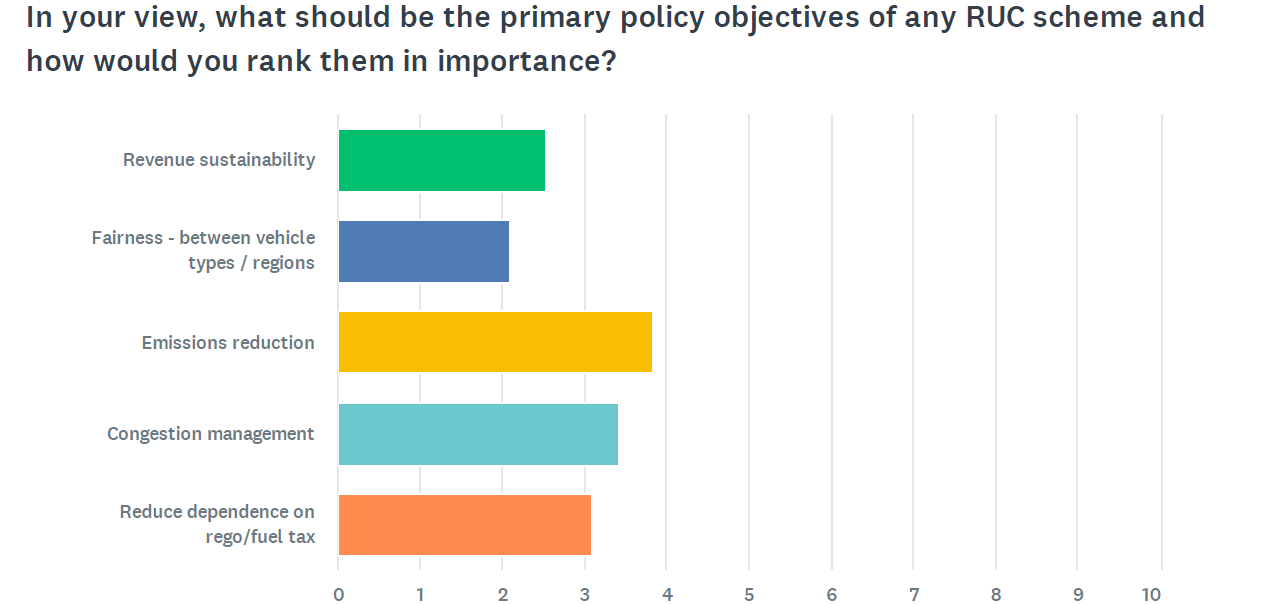
- A clear majority of respondents ranked revenue sustainability and fairness among the top objectives for any RUC scheme.
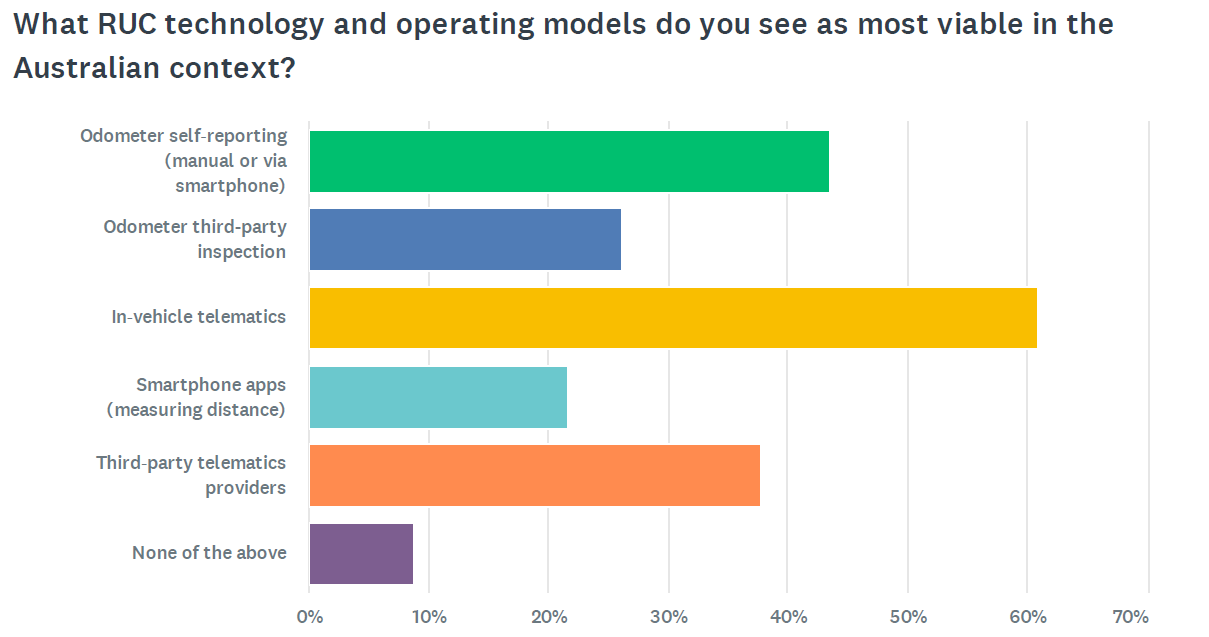
- By a large margin telematics were seen as a the most viable long-term approach for RUC in Australia.
- Also identified was odometer‑based distance charging as a potentially useful mechanism.
- There was widespread emphasis on national consistency and interoperability, with repeated references to the need for national standards and a single operating model across jurisdictions.
- A large number of comments highlighted equity impacts on low‑income, rural and remote drivers, and called for simple but targeted concession mechanisms rather than highly complex tariff structures.
- Respondents emphasised “keep it simple initially” – start with plain distance‑based RUC replacing fuel excise, then refine for equity and externalities.
- National consistency and interoperability: need a nationally agreed approach, EU‑style standards, and coordination across Commonwealth, states, toll roads, and private providers.
Stakeholder feedback across the ITS Australia survey paints a clear picture: there is strong, informed support for road user charging as a necessary evolution of Australia’s road funding model, but that support is conditional on how the scheme is designed and introduced.
Expert industry respondents canvassed from ITS Australia membership see RUC less as an abstract technology project and more as a practical response to the erosion of fuel‑excise revenue and the need for a clearer, fairer user‑pays system as EVs and more efficient vehicles become mainstream.
Across the responses, revenue sustainability and fairness between vehicle types and regions emerge as the dominant policy objectives, consistently ranked above emissions reduction and congestion management. Stakeholders broadly agree that all vehicles should ultimately contribute, yet they warn that reforms must avoid the perception that RUC is simply an “EV tax” or an additional impost layered on top of existing charges. Instead, they argue that RUC should be framed as modernising and progressively replacing legacy funding instruments, including fuel excise, rather than stacking new charges on top of old ones.
On implementation, the survey reveals a strong preference for a “simple first, smart later” pathway. The clear majority view is that initial schemes should focus on straightforward, odometer‑based distance charging that is easy to explain, low‑cost to administer and relatively light‑touch from a privacy perspective. More complex telematics‑based models – with time‑of‑day, location and congestion components – are seen as valuable future options, but not an appropriate starting point given concerns about cost, social licence and political risk. Respondents repeatedly stress that trying to solve revenue, congestion and emissions all at once, with a highly data‑intensive system on day one, is more likely to delay or derail reform than to secure durable change.
Privacy, cyber security and data governance feature prominently as non‑negotiable design conditions. Many respondents favour a base model that collects only what is strictly necessary to calculate charges – typically distance totals over a period – with any detailed location data either not collected or stripped out early in the process. There is strong advocacy for explicit legal limits on secondary use, with RUC data clearly ring‑fenced from law enforcement, general surveillance and unrelated regulatory purposes, backed by robust assurance and independent oversight. Stakeholders also highlight the importance of user transparency and choice, including the ability to see and verify their own records and to opt into more data‑rich options only where there are clear benefits in return.
Equity and political acceptance are recurring themes throughout the qualitative responses. While there is support for a consistent user‑pays principle – including EVs “paying their way” – respondents are acutely aware of potential impacts on low‑income households, regional and remote drivers, and people who rely on longer-distance travel. The prevailing view is that the core tariff structure should remain simple and transparent, and that social equity objectives are better handled through targeted concessions, credits or caps delivered via existing welfare and tax systems, rather than through an overly intricate RUC price schedule. Several respondents also emphasise that the greatest barriers to successful RUC are likely to be political and perceptual rather than technical, underscoring the need for a clear narrative about fairness, replacement of fuel excise, and visible reinvestment in the road network.
Taken together, the findings suggest that the ITS and transport technology community is ready to support RUC as a major structural reform, provided it is anchored in clear objectives, implemented in an incremental and pragmatic way, and underpinned by strong safeguards around privacy and equity. The sector looks to ITS Australia to play a convening and standards‑shaping role – supporting pilots, national architectures and harmonised data standards, and helping articulate a coherent transition from fuel excise to distance‑based charging – rather than simply endorsing any specific technical solution.
For decision‑makers, the message is that there is a window of opportunity: a well‑designed, clearly explained RUC can command both stakeholder and public support, but an over‑complex or perceived “double tax” scheme risks losing legitimacy before it begins.
The RUC survey captured responses from stakeholders across the transport ecosystem. The instrument is expert/stakeholder‑facing, not a general public poll, so sentiment reflects informed practitioners and industry perspectives, not lay opinion.
Primary policy objectives of RUC
Ranked objectives (via average scores) focus on:
- Revenue sustainability – maintaining a stable, fuel‑neutral funding base is a primary objective.
- Fairness – particularly between vehicle types and regions, including a view that EVs should “pay their way” while avoiding inequity for rural/low‑income users.
- Emissions reduction and congestion management – widely seen as valid but secondary levers that RUC could support, especially if location/time weighting is used.
- Reducing dependence on rego/fuel tax – recognised as necessary given EV uptake and efficiency gains.
Sentiment summary:
- Strong conceptual support for RUC as a revenue and fairness reform, with conditional interest in using it to manage emissions and congestion where politically feasible.
- Several responses stress the need for a clear, singular policy intent (revenue vs emissions vs congestion) to avoid confusion.
Preferred technology and operating models
- Telematics was the most favoured of options with more than 60% of respondents recommending that this technology would offer the most user-friendly and adaptable model.
- Odometer‑based approaches (self‑reporting, verified, API‑linked to registration) are widely seen as a useful starting point due to simplicity, cost, and ease of application.
- Several advocate hybrid models:
- Default odometer reporting, with opt‑in telematics for more sophisticated pricing or incentives (e.g. congestion management).
- Pre‑paid km bundles, annual true‑up, or manufacturer / service‑centre reporting to keep administration light.
Key technical and interoperability challenges
- Privacy, security, and data protection repeatedly identified as top concerns.
- National consistency and interoperability: need a nationally agreed approach, EU‑style standards, and coordination across Commonwealth, states, toll roads, and private providers.
- Heterogeneous fleet:
- Older vehicles without connectivity.
- Managing both connected and non‑connected vehicles without unfairly penalising one group.
- Equity and political acceptance: some respondents argue the main challenge is political and perceived fairness, not the technology itself.
- Integration challenges: with registration, tolling, enforcement, OEM data, and third‑party telematics, plus risk of vendor lock‑in.
Phasing and community needs
Strong expectation that RUC should ultimately apply to all vehicle types, including EVs and ICE, with EVs not permanently exempt.
- Many respondents favour simple distance‑based pricing, with flexibility to layer in weight, emissions, and location factors over time.
- Divergent views on concessions:
- Some favour universal, simple RUC with separate welfare/tax instruments handling equity (e.g. via Services Australia or tax system).
- Others support targeted concessions or caps for regional/remote users, low‑income households, people with disability, small operators, often via credits, distance caps or rebates, not complex pricing schedules.
- Several emphasise “keep it simple initially” – start with plain distance‑based RUC replacing fuel excise, then refine for equity and externalities.
Privacy, Cyber‑Security and Data Governance: Required protections
Top issues:
- Data minimisation: many respondents want distance totals only, with no or limited location data for the base scheme.
- No secondary use: strong calls for clear legislative limits – RUC data must not be used for law enforcement, surveillance, speed enforcement, or unrelated government purposes.
- Anonymisation and encryption:
- Suggestions include rotating cryptographic identifiers and onshore storage.
- Preference for independent governance and strong audit over both public and private operators.
- Choice and transparency:
- Users should be able to view their data and charges, choose between distance‑only vs location‑based options, and have clear consent mechanisms.
Integration with ITS and Payment Systems: Opportunities and barriers
Opportunities:
- Integration with tolling back‑offices, fleet management systems, and existing digital payments to reuse infrastructure and simplify billing.
- Use of ITS data to support congestion pricing, demand management, and better network analytics.
Barriers:
- Policy and legislative fragmentation, lack of national system architecture, and jurisdictional rivalries.
- Public mistrust, privacy concerns, and fear of “big brother” tracking.
- Legacy commercial arrangements and potential “rent‑seeking” by toll operators or private providers if not well regulated.
Recommendation (integration strategy):
- Treat tolling, ITS, and RUC as part of a coherent national mobility charging ecosystem, but avoid over‑integrating on day one; keep RUC functionally independent while reusing back‑office capabilities where it reduces cost and complexity.
- Develop a national integration roadmap led by government and informed by ITS industry and research institutions.