Behavioral Change for Sustainable Transport
Improving public transport accessibility and travel times, enhancing walking and cycling conditions, and removing free workplace parking all materially reduce driving and increase sustainable modes – and could reduce reliance on car ownership.
Sustainable transport strategies across the world have increasingly relied on technology — better vehicles, cleaner fuels, digital platforms — but have struggled to shift how and how much people actually travel. The fundamental challenge is not just the availability of alternatives to the car, but whether people choose them. This research programme, produced by the Institute of Transport and Logistics Studies (ITLS) at the University of Sydney and funded through the iMOVE Cooperative Research Centre (CRC), was designed to address that gap directly.
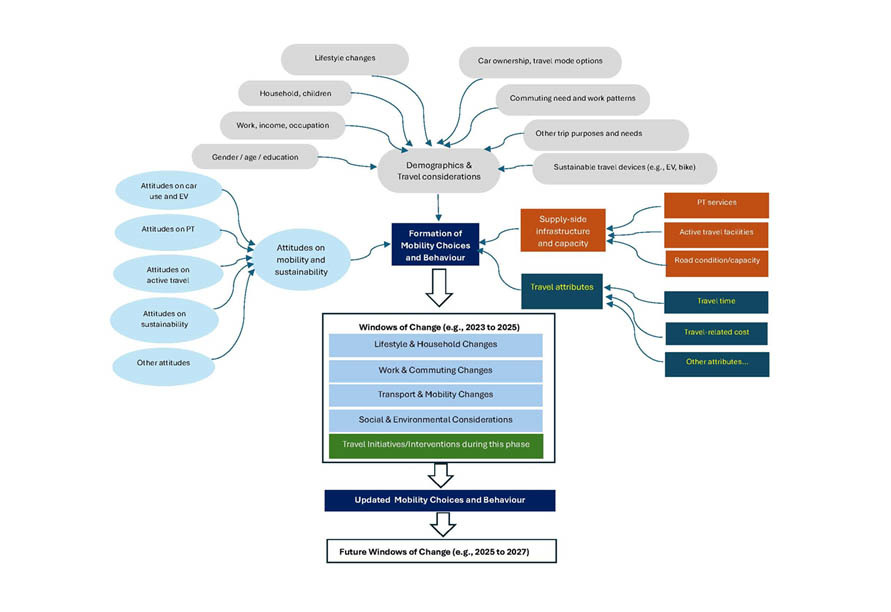
The core motivation was to understand when and why people change travel behaviour — specifically by focusing on "windows of change" (WoC): life events and contextual shifts (moving home, changing jobs, starting a family, financial change) that make individuals more open to revising their travel habits. Prior evidence suggested these moments are underexploited by policy and industry. Without knowing which influences most strongly drive people toward or away from sustainable modes, governments, employers, developers, and transport agencies are left designing interventions based on intuition rather than evidence.
The research also responded to growing recognition that the transport sector's sustainability challenge is multi-dimensional. While vehicle electrification is accelerating, early evidence pointed to a troubling rebound effect — greener vehicles may lead to more driving, not less. Understanding the full system of influences, beyond just vehicle technology, was therefore critical.
Methodology
The research drew on a large-scale cross-country survey conducted in 2025 across seven countries — Australia, Finland, New Zealand, the United States, the United Kingdom, Singapore, and Sweden — with over 4,000 respondents.
Participants were asked which changes since 2023 had affected their household travel, and how frequently they now travelled by car (as driver and passenger), public transport, walking, and active/micromobility modes in a typical week. Seventy-one potential influences were identified and grouped into four domains:
- Lifestyle and household — moving home, health events, financial changes
- Work and commuting — job changes, flexible and hybrid work patterns
- Transport and mobility — car ownership changes, public transport improvements, bicycle and e-scooter purchases
- Social and environmental — environmental concern, family influence, public campaigns
To quantify how each influence changes weekly trip frequencies by mode, negative binomial count models were applied — a statistically robust approach for count data — controlling for socioeconomic factors and country context. The result was a set of direct elasticity estimates showing the magnitude of mode shift associated with each influence.
The quantitative survey findings were complemented by multi-stakeholder roundtables with policymakers, transport agencies, employers, developers, and researchers, providing qualitative insight into the systemic and institutional dimensions of behaviour change.
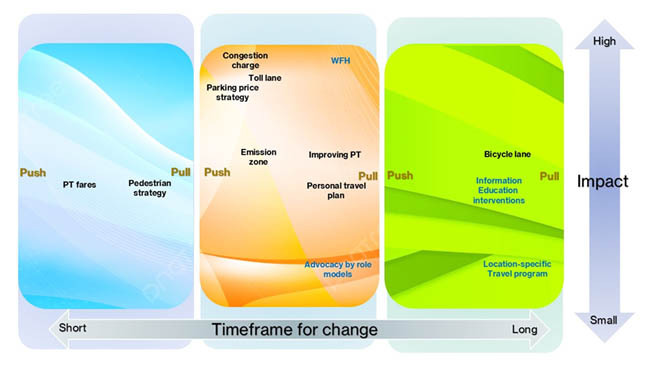
The Single Strongest Lever: Car Ownership
No longer owning a car is the most powerful predictor of sustainable travel. This WoC is associated with large increases in public transport use, walking, and active modes, and a very large reduction in driving — while also increasing car-passenger trips so that overall mobility is maintained. The implication is stark: sustainable transport strategies that focus solely on improving alternatives, without also addressing car ownership levels, are likely to underperform.
Public Transport: Access and Time Matter Most
Improving the accessibility of public transport in a local area, and improving route efficiency to reduce travel time, both produced strong increases in PT trips and walking — and modest reductions in car driving. Switching to public transport for commuting was associated with a large rise in both PT and walking trips. These are highly actionable findings: the quality and coverage of PT networks are directly within the control of governments and transport agencies.
Employers Are a Powerful, Underused Lever
The research found that employer actions — both supportive and restrictive — have significant impacts on travel behaviour:
- Removing free workplace parking markedly reduces car trips and increases PT and walking
- Mobility-related perks (subsidised PT, carpooling, cycling, or e-scooter incentives) increase PT, walking, and active travel
- Health and wellness facilities (showers, lockers, end-of-trip infrastructure) support active commuting
- By contrast, free employer-provided parking — especially when paired with EV charging — strongly reinforces car use
Despite this evidence, most employers have not yet treated commuting as a strategic lever for sustainability or wellbeing.
Active and Micromobility Modes Work
Purchasing bicycles, e-bikes, and e-scooters — as well as self-reported increases in walking and cycling — are associated with clear increases in active trips and reductions in driving. These effects are concrete and measurable, reinforcing the value of investment in active mode infrastructure and subsidy programs.
The Electrification Paradox
One of the most important and counterintuitive findings is that replacing a petrol or diesel car with an electric or more fuel-efficient vehicle is associated with higher car driving. Rather than reducing car dependence, EV adoption — if not paired with demand management — adds congestion and increases vehicle kilometres travelled, even as per-km emissions fall. This presents a significant policy blind spot: current EV incentive programs, if not complemented by road pricing or parking reform, risk locking in more driving, not less.
Caregiving Is a Critical but Neglected Window
Parenting and caregiving phases were identified as a pivotal WoC where households default to the car — and stay there. The complexity and time-sensitivity of chained trips (e.g., dropping children at school before commuting) make current public transport and active mode options inadequate for many families. This is also a gendered issue: caregiving responsibilities remain disproportionately borne by women, meaning car dependence during family formation phases has unequal impacts across the population.
Online Shopping Can Increase Driving
Greater use of click-and-collect is linked to more car-driver trips. "Online shopping to reduce travel" only weakly offsets this and may shift trips to delivery vehicles rather than eliminating them. This is a growing and often overlooked influence on transport demand that requires active management.
Campaigns and Environmental Awareness Help — But Modestly
Public campaigns and growing environmental concern do positively correlate with more sustainable travel behaviour — increasing PT, walking, active modes, and car-passenger use. However, their effect sizes are smaller than structural changes (infrastructure, pricing, car ownership) and are unlikely to be sufficient on their own.
Almost a third of all Greenhouse Gas (GHG) emissions in Australia are caused in large part through transport of goods and people and while there is no single solution to reducing emissions and other negative environmental and societal impacts, the transport sector has a range of opportunities to positively impact our environment and transition away from reliance on private vehicles. However, while opportunities are available to deliver more sustainable transport, there is no silver bullet and a top-down approach to reducing the environmental impact would be unlikely to deliver on GHG reduction targets. The desire, however, to reduce local air pollutants that are increasingly more harmful to humans, needs recognising and is part of any assessment of sustainability initiatives designed to reduce chemical pollution.
A non-exhaustive list of interventions to support the decarbonising of the transport sector include:
- Public and active (walking, cycling…) transport infrastructure and services
- Road user charging reform
- Mode shift to more sustainable transport
- LZEV fleet transition
- Fuel standards
- Circular low-carbon supply chains
- Integrated transport planning
- Co-modality and (passenger and freight) and micro-freight
The combination of these reduction strategies is designed to allow the transport sector to play an important role in reducing the sector’s environmental footprint and GHG emissions (including local air pollution) more generally – by both reducing emissions through more efficient infrastructure and services and delivering more sustainable transport systems and networks enabling increased active and public transport. Such a shift towards more sustainable transport modes in Australia would require a co-ordinated effort by governments, industry, and individuals, with incentives as appropriate and affordable, and a willingness to invest in the necessary infrastructure and policies.
Crucially, decarbonising the transport sector through transitioning from internal combustion engine vehicles to LZEV’s will not solve the majority of issues that face the transport sector. Enabling people to choose more sustainable public and active transport will have a more beneficial impact in the short and long term. Hence this project seeks to understand how policy and infrastructure actions can make that transition work for cities and communities in Australia.
While some of the available policy interventions and recommendations would seem reasonable there is a vast difference between developing and encouraging and promoting activities to deliver more sustainable transport systems and actually gaining traction with Australians to drive action on these steps. This research, beginning with an extensive literature review, will uncover real attitudes and actions that are best likely to deliver actual change to a more sustainable transport system and include recommendations for policy makers and operators to expedite those changes equitably with evidence-based policies and interventions. The literature review will also investigate the economic impacts and potential cost benefit analysis of transition to more sustainable transport. We will draw on both academic and grey literature and available sources such as the National Walking and Cycling Participation Survey and state Walking and Cycling strategies.
As recognised in the recently published Transport for London Cycling Action Plan 2[1], swapping private cars, regardless of the energy propulsion source, for sustainable modes is essential to bridging the 'gap' to achieve emissions reduction targets whilst also delivering substantial cost savings to the health system (it is estimated that savings to the National Health Service in treatment costs over 25 years if all Londoners did 20 minutes of physical activity each day would be over $3B AUD). Additionally, with an increasing population residing in urban and suburban communities, the planning allowance of car-free developments could reduce cost of housing and enable the building of more sustainable housing. Active transport is both economically efficient and with the right infrastructure, and sustainability culture, can reduce traffic and parking congestion. In rural and regional areas of low-density settlement patterns, a rethink of how best to use the flexibility of the car in a sharing setting needs further consideration.
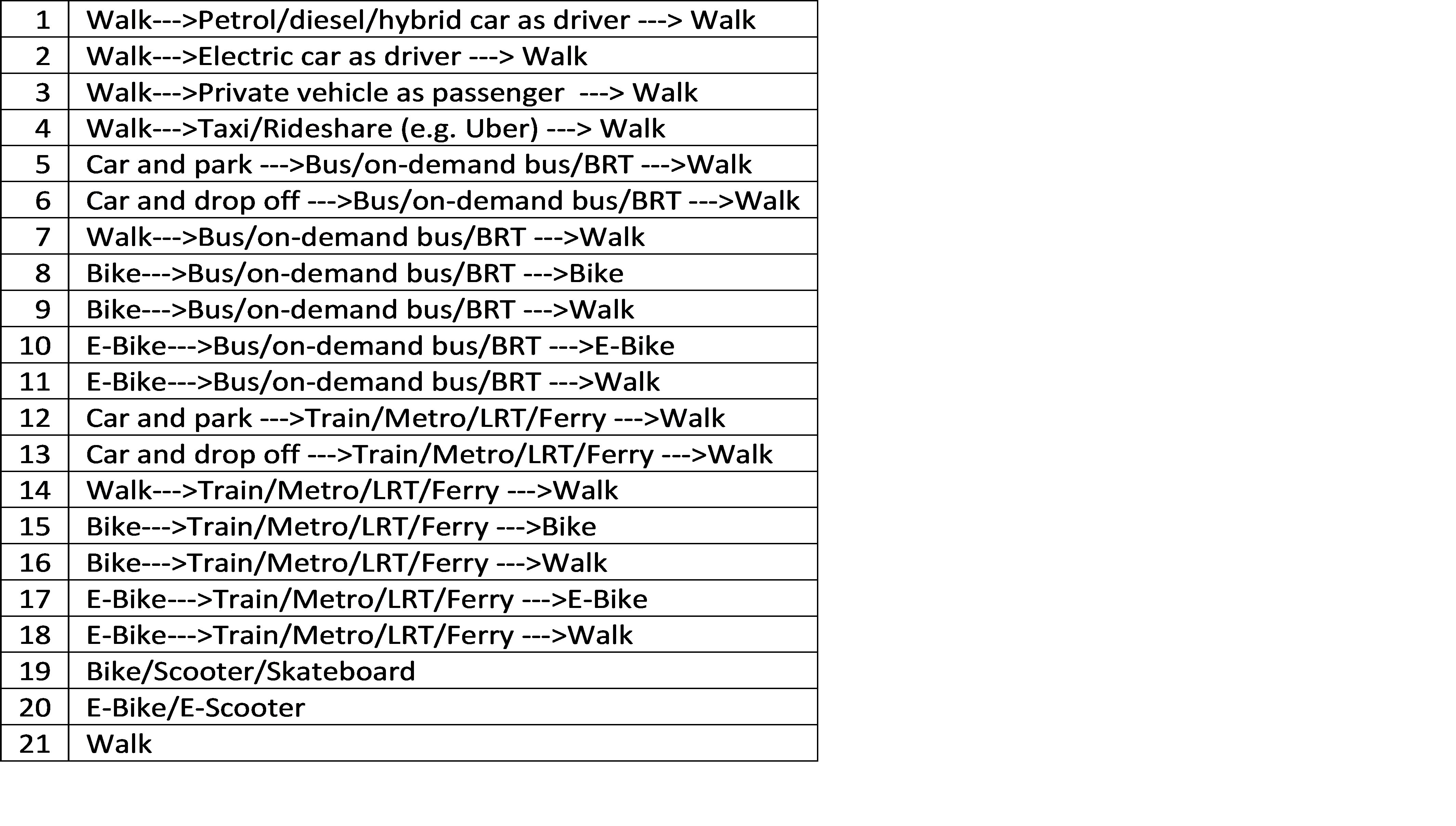
To maximise the benefits for Australia, there needs to be a well-planned and collaborative approach. To that end, we will design and implement an Australia-wide online survey of demographically representative citizens to better understand their appreciation of, and willingness to support, sustainable transport transitions (“Survey”). The Survey will be designed in which revealed and stated preference data is used to identify current and future interest in the frequency of using a richer set of motorised and non-motorised modes for all stages of a door-to-door journey, distinguishing trip purpose, time of day, and day of week. Trip frequency over a 7-day week is much more informative than the more traditional choice of a mode survey approach for a typical day. All modes will be investigated for the access, main and egress modal contest, as summarised in the table below (BRT – Bus Rapid Transit / LRT Light Rail Transit / Active modes / Car).
Outcomes of the Survey will be analysed to offer insight into preparing a pathway forward for sustainable transport services in Australia and enable emissions reductions to meet more ambitious decarbonisation targets. Although the survey is a once-off activity in this research, the opportunity to continue to use the Survey to gather longitudinal data to monitor the success or otherwise of initiatives to increase the sustainability footprint will be of value to all industry partners.